* Does not apply to Priority Delivery. Priority delivery orders are not eligible for free delivery.
Spark Rewards is located in Canada
All prices are in CAD
Security Method
The name on your order must match a valid photo ID that is required to be
checked on pickup / delivery. If the order is pre-paid the credit card used
will also be verified for name and credit card number. Any discounts requiring
ID (student discount, senior or veteran) will require ID to be present
at time of pick up.
Customer & Payment Verification
All transactions on this site are safe and secure. Any personal
information you give us will be handled in the strictest confidence according
to our
Privacy Policy
.
Refund Policy
Please review our
return and refund policy
as it may differ based on the shop and province in which you have purchased from.
We use cookies to enable the proper functioning and security of
our website, and to ensure we give you the best experience. By
continuing to use this website, you consent to the use of these
cookies. You can change your cookie settings in your browser at
any time. Learn more on how we use cookies in our
Privacy Policy
Ever wonder why cannabis prices can feel like a guessing game from one province to the next? This article unpacks why cannabis prices vary between Manitoba and British Columbia, diving into the key factors that drive these differences. You’ll learn how provincial regulations, competition, and producers influence cost, empowering you to make smarter purchasing decisions. By understanding these dynamics, you’ll be better equipped to find value and consistency in your cannabis shopping, no matter where you are in Canada.
The Cannabis Price Puzzle
It’s a common head-scratcher for Canadian cannabis shoppers: you spot a favourite strain or product online, only to find its price tag looks completely different depending on whether you’re checking MB vs BC weed prices. It’s confusing, right? Seeing seemingly similar items priced so differently can make it tough to judge true value, leading to frustration and sometimes, buyer’s remorse.
Understanding these provincial discrepancies isn’t just trivia, it’s crucial for making informed decisions. By knowing what factors influence weed prices Canada-wide, and specifically between provinces, you can shop smarter, get more bang for your buck, and ensure you’re not overpaying.
Cannabis Pricing Factors Overview
Generally, British Columbia (BC) tends to have lower average cannabis prices than Manitoba (MB) across most product categories. This difference is primarily driven by BC’s more mature and competitive market, distinct provincial tax structures, and differing distribution models. But before we compare MB vs BC weed prices directly, it helps to understand how cannabis gets its price tag in the first place. Think of it as a journey from seed to sale, with costs accumulating at each stop.
Here’s a simplified look at the key price drivers influencing the retail prices you see:
Cultivation costs include labour, equipment, and maintaining quality in facilities, whether indoor with high energy use or outdoor with natural sunlight. Larger producers can sometimes achieve lower per-gram costs.
After harvest, processing and manufacturing add expenses. Flower needs curing (a drying and finishing process impacting flavour and potency) and trimming. Vapes, oils, or edibles require extraction (separating cannabinoids like THC and CBD from the plant material using solvents or pressure) and further manufacturing, which means specialized labour and material costs. Terpenes, the aromatic compounds influencing scent and flavour, often necessitate more careful processing, adding to a quality product’s cost.
Packaging and labelling also contribute. Every legal cannabis product requires specific, child-resistant packaging and detailed labelling to meet Health Canada regulations. Material and compliance costs add to the overall expense.
Provincial taxes and excise duties, including federal excise duty and provincial sales taxes, directly increase the final price.
Distribution and logistics, involving transportation and warehousing from producer to retailer, also add to the supply chain cost.
And here’s a bonus non-obvious insight: Your chosen cannabis format (e.g., dried flower, pre-rolls, vape pens, edibles, concentrates) can profoundly affect long-term value and repeatability. A gram of budget flower might seem cheaper upfront, but if it’s not the right potency or format for you, meaning you use more of it, or it doesn’t provide your desired experience consistently, it could be less cost-effective than a slightly pricier, more efficient alternative like a vape cartridge.
MA vs BC Weed Prices: Why Do They Differ?
Now that we understand the general pricing mechanisms, let’s zero in on what makes MB vs BC weed prices stand out in their pricing structures.
Provincial Distribution Models
As mentioned, one of the biggest drivers of the differing MB vs BC weed prices is how each province handles distribution:
Manitoba:
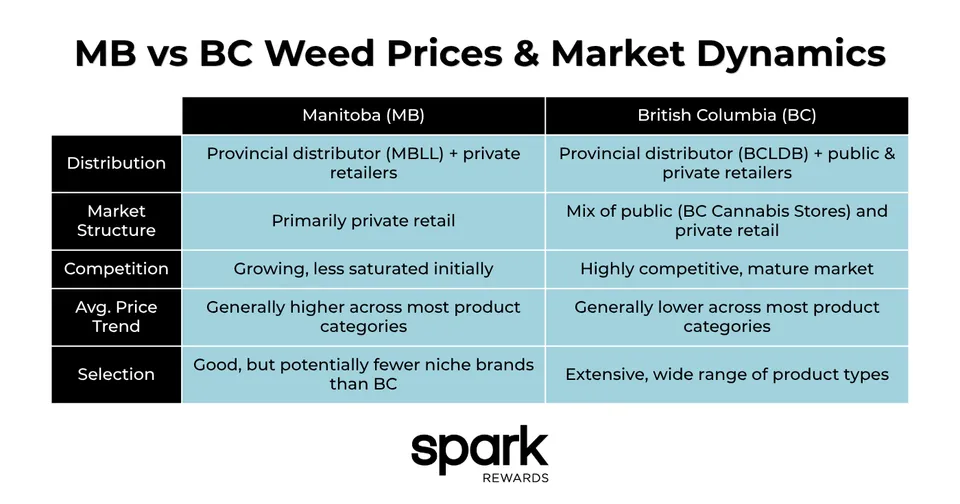
This province operates with a primarily private retail model, but with a twist: Manitoba Liquor & Lotteries (MBLL) oversees the distribution of all cannabis products to these private retailers. This means licensed producers (LPs) sell their products to MBLL, which then distributes them to stores.
British Columbia:
BC uses a hybrid model, featuring both government-run BC Cannabis Stores (BCCS) and a robust private retail sector. The BC Liquor Distribution Branch (BCLDB) handles the wholesale distribution to both public and private stores. This mixed approach, combined with BC’s higher number of licensed producers, fosters greater competition among retailers. More competition generally means more pressure on prices, often leading to lower costs for consumers.
Taxation & Excise Duties
While federal excise duties apply consistently across Canada, provincial sales taxes (PST) and any additional provincial excise duties can vary. These provincial-level taxes add directly to the final sticker price, contributing to price differences even for the exact same product.
Market Maturity & Competition
British Columbia has a longer and deeper history in the cannabis market, both legal and grey. This has cultivated a more mature and fiercely competitive landscape among cultivators, processors, and retailers. A more saturated market often drives prices down as businesses vie for consumer dollars.
While Manitoba’s market has grown significantly since legalization, it’s generally been less intensely competitive (historically) than BC’s. As the market matures and more retailers and brands enter, we could see more aggressive pricing, but for now, this less saturated environment can contribute to higher average prices.
Here’s a quick overview of some key differences:
Navigating the Market for Smarter Cannabis Shopping
Knowing why MB vs BC weed prices differ is a great start, but how does this help you make smarter decisions as a shopper? It’s all about getting consistent results and avoiding wasted money.
Start by looking beyond the immediate price tag. Consider the “packaged on” date (especially for dried flower and concentrates), the reported terpene profiles, and your desired potency. A slightly higher price for a product that’s fresh, effective, and truly enjoyable will offer better overall value than a super-cheap product that might be less potent or simply not right for you.
You can also use online platforms like Spark to quickly compare prices across multiple retailers. This helps ensure you’re getting the best deal for the products you want, no matter which province you’re in.
And lastly, always check the “packaged on” date for freshness (especially for flower and concentrates). Newer dates generally mean a fresher product.
Once you’re home, store your cannabis properly in a cool, dark, airtight container to preserve its integrity and extend its shelf life. This prevents the degradation of terpenes and cannabinoids, ensuring your purchase maintains its perceived value and potency for longer.
If you’re a value-focused shopper, master the unit price. For dried flower, calculate price per gram. For vapes, price per milligram of THC or total volume. For edibles, price per milligram of THC. This helps you compare apples to apples, even across formats and products, ensuring you’re getting the most cannabinoids for your dollar.
If you’re an experienced shopper, don’t be afraid to experiment with lesser-known brands or new formats! Market competition drives innovation and better prices, and sometimes the best value is found just outside your usual picks as newer brands try to establish themselves with competitive pricing and quality.
And remember: a valid government-issued ID is ALWAYS required to purchase cannabis products, and regulated packaging (including the excise stamp) helps confirm you’re buying from the legal supply chain.
MB vs BC Weed Prices: FAQs
Why are edibles often more expensive per mg of THC than flower?
Edibles involve more complex manufacturing, precise dosing, and specialized child-resistant packaging. These steps increase the production cost per milligram of THC compared to dried flower, which typically requires less processing.
Do online stores or physical dispensaries have better prices in MB/BC?
It varies! Online stores like Spark often have lower overheads, potentially offering more competitive pricing or promotions. However, physical stores might feature flash sales or unique inventory.
Can I expect prices to change a lot between MB and BC in the future?
The Canadian cannabis market is constantly evolving! As Manitoba’s market matures and competition grows, prices could become more competitive. Similarly, BC’s prices might fluctuate due to market saturation, new entrants, and shifts in supply and demand. Staying informed through resources like Spark’s blog is crucial for navigating these changes.
What’s the best way to compare value for different cannabis formats (vapes, edibles, flower)?
Focus on “cost per dose” or “cost per milligram of active cannabinoid (THC/CBD)” rather than just the package price. Calculate what you’re paying for the active ingredient you’ll consume or the desired experience. This helps you determine which format truly offers the most value for your usage habits.
Closing Thoughts on Canadian Cannabis Pricing
Navigating the cannabis market in Canada, especially when comparing provinces like Manitoba and British Columbia, means understanding that price differences aren’t random. They’re a direct result of diverse provincial regulations, unique market dynamics, and varying supply chain efficiencies. By focusing on factors beyond just the sticker price, considering freshness, potency, and your preferred experience, you can make smarter purchasing decisions. Utilize online tools and comparison shopping to unlock better value, ensure consistent quality, and get more out of every cannabis purchase, wherever you are in Canada.